

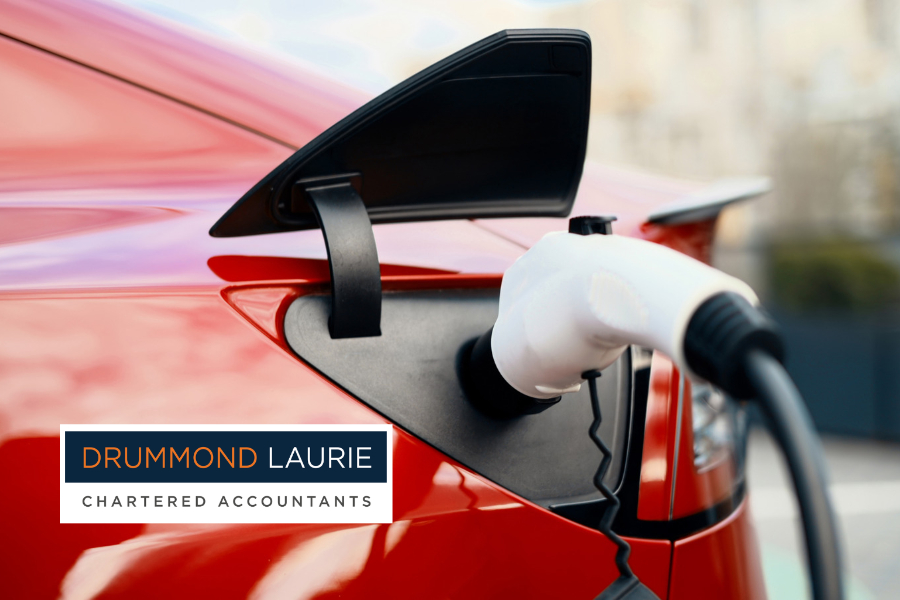
For individuals and businesses, favourable electric company car tax has always been an attraction. However, rising benefit-in-kind (BIK) rates are gradually narrowing the tax advantage. Louise Cunningham explains why individuals and businesses now need to look more closely at the tax implications of changes to electric company car tax.

Why are electric company cars tax-efficient?
For businesses and individuals, the favourable tax treatment of electric company cars, particularly the low benefit-in-kind (BIK) rates, remains significant. According to HMRC’s provisional statistics for 2024/25, full electric vehicles accounted for over half of delivered company cars.
While they remain tax-efficient in general, a more detailed assessment is now needed as a result of upcoming electric company car tax changes.
Benefit-in-kind tax rates for electric company cars are on the rise
When electric company car BIK rates were as low as 1%, the personal tax implications of choosing a more expensive vehicle were relatively modest. For the 2026/27 tax year, the BIK rate for a fully electric company car is 4%, with further increases scheduled and an additional increase announced for 2030/31:
| Tax year | Electric Car BIK rate |
|---|---|
| 2026/27 | 4% |
| 2027/28 | 5% |
| 2028/29 | 7% |
| 2029/30 | 9% |
| 2030/31 | 10%* |
*The 2030/31 rate was announced at Budget 2026 and is subject to enactment in the Finance Bill 2026/27.
Compared to most petrol and diesel vehicles, the rising BIK rates remain significantly lower. However, the increases mean that for many business owners and employees, the choice of electric company car is now more important.
Electric company car tax and why list price really matters
Company car tax is generally calculated by multiplying the vehicle’s taxable list price (often called its P11D value) by the applicable BIK percentage. This broadly includes the published price when new, VAT, delivery charges and taxable accessories. Adjustments can apply, including qualifying employee capital contributions, payments for private use and periods when the car is unavailable.

Importantly, the taxable list price does not necessarily reflect the amount the business actually pays. Negotiating a purchase discount may reduce the vehicle’s cost, but does not normally reduce the employee’s BIK liability.
The implications of rising benefit-in-kind rates for electric cars
Consider two fully electric company cars with list prices of £35,000 and £60,000.
For a Scottish higher-rate taxpayer paying Income Tax at 42%, the annual personal tax liability would be:
| Tax year | £35,000 car | £60,000 car |
|---|---|---|
| 2026/27 | £588** | £1,008** |
| 2029/30 | £1,323** | £2,268** |
**Illustrative figures assume a full year’s private availability, no employee contributions and that the entire benefit is taxed at 42%. For comparison, the 42% Scottish higher rate applicable in 2026/27 is assumed to remain unchanged in 2029/30; actual future liabilities may differ.
By 2029/30, choosing the more expensive car would result in an additional £945 of personal tax to pay each year.
The takeaway for individual taxpayers? Going electric for your company car remains tax-efficient. But the list price and cost of optional extras on an electric company car can make a significant difference to the overall tax saving, and in addition to this, tax savings could reduce over the car’s lease/useful life, with the electric car BIK rates increasing.
Electric company cars and salary sacrifice schemes
Fully electric company cars benefit from an exemption from the optional remuneration arrangement (OpRA) valuation rules. Therefore, cars with CO2 emissions of 75g/km or less, including fully electric cars, continue to be taxed under the normal company car benefit rules without comparison with the salary foregone in a salary-sacrifice arrangement.
Electric company cars and business tax relief incentives
In addition to the benefits for employees, electric vehicles also offer attractive tax reliefs for businesses.
Limited companies, sole traders and partnerships purchasing qualifying new and unused zero-emission cars may be eligible for a 100% first-year capital allowance. This allows qualifying expenditure to be deducted when calculating taxable profits for the period in which the expenditure is incurred.

For sole traders and partnerships, private use by the business owner restricts the allowance to the business-use proportion; different treatment applies where a company provides a car to an employee or director. Second-hand electric cars do not qualify for this 100% first-year allowance, although writing-down allowances may be available. Disposing of the car later may also create a tax charge.
Under the current rules, the 100% first-year allowance for qualifying new and unused zero-emission cars is available for expenditure incurred by 31 March 2027 for Corporation Tax, or 5 April 2027 for Income Tax. These deadlines should be checked again before a purchase is committed to.
For employers, lower BIK values can also mean lower Class 1A National Insurance contributions than for conventional company cars. The Class 1A rate is 15% in 2026/27, and the charge is generally based on the taxable benefit.
However, the overall tax position will depend on several factors, including:
- Whether the vehicle is purchased or leased,
- VAT recovery restrictions,
- Any private use, and
- The associated running costs.
Businesses should consider the full financial picture rather than focusing solely on the headline tax incentives.
Making the most tax-efficient choice when it comes to electric company cars
Despite the changes to their tax treatment, electric company cars remain an attractive option for many businesses and employees. The zero-emission BIK rate rises from 4% in 2026/27 to 9% in 2029/30, with a further increase to 10% announced for 2030/31, making careful planning more important.
The key consideration is not simply whether to choose an electric car, but which electric car offers the best balance between practicality, cost and tax efficiency.
At Drummond Laurie Chartered Accountants, we help business owners and employees understand the tax implications of their vehicle choices and ensure they are making well-informed, tax-efficient decisions.
For an initial discussion about electric company car tax, get in touch with Louise Cunningham.
Connect with Drummond Laurie Chartered Accountants on LinkedIn, Facebook and X
About the author
Louise Cunningham qualified as a Chartered Accountant with the Institute of Chartered Accountants of Scotland (ICAS) in 2018. She manages a diverse portfolio of clients across sectors, including construction, manufacturing, packaging, property and professional services.
Connect with Louise on LinkedIn.