


Significant FRS 102 lease accounting changes are now taking effect, with potentially significant implications for businesses that rent premises, vehicles, equipment or other assets. Heather Young examines the reporting implications for owner-managed businesses and simplifies the key considerations in our latest insight.

Article contents:
- What are the FRS 102 Lease accounting changes?
- FRS 102 changes will mean more leases are recognised on the balance sheet
- What do the FRS 102 changes mean for your business?
- When do the FRS 102 Lease accounting changes take effect?
- Can my business qualify for an exemption under the FRS 102 Lease accounting changes?
- How can I prepare my business for the FRS 102 Lease accounting changes?
What are the FRS 102 Lease accounting changes?
Under the revised FRS 102 Section 20, most leases will be recognised on the balance sheet, rather than simply recording rental payments as an expense in your profit and loss account.
For some owner-managed businesses, this could result in substantial changes to their reported assets, liabilities and financial performance. This means it is important to understand the changes and the implications for your business.
In practice, the impact will depend on three factors:
- The nature of each lease
- The total number of leases your business holds
- The duration of each existing lease arrangement.
It’s important to note that not every rental or hire agreement will qualify as a lease for accounting purposes.
FRS 102 changes will mean more leases are recognised on the balance sheet
Previously, businesses distinguished between operating leases and finance leases, with many operating lease commitments remaining off the balance sheet. Under the revised FRS 102 lease accounting changes, most leases will require businesses to recognise:
- A right-of-use asset: representing the right to use the leased property or equipment
- A lease liability: representing the obligation to make future lease payments.
The lease liability is generally calculated using the present value of future lease payments, discounted at an appropriate rate. Instead of recognising rental expenses in the traditional way, businesses will generally recognise depreciation on the right-of-use asset and interest on the lease liability.

The accounting requirements for businesses acting as lessors remain largely unchanged.
What do the changes to FRS 102 mean for your business?
Although the new requirements do not change the rental payments your business makes, they may significantly affect how its financial position and performance are presented.
Therefore, your business may experience:
- Increased assets and liabilities as leases are brought onto the balance sheet
- Changes to reported profits, with rental expenses replaced by depreciation and interest charges
- Changes to key financial ratios, including gearing, EBITDA and interest cover
- Potential implications for borrowing arrangements, particularly where lending agreements contain financial covenants.
If your business has loans or overdraft facilities, you should review the lending agreements to understand whether the revised accounting treatment affects existing covenant calculations. Where necessary, discussions with your lenders should take place in advance.
When do the FRS 102 Lease accounting changes take effect?
The revised FRS 102 Lease accounting requirements apply to accounting periods beginning on or after 1 January 2026, although early adoption is permitted subject to the relevant requirements.
Therefore:
- Businesses with a December year-end will generally apply the changes from 1 January 2026
- Businesses with a March year-end will generally apply the changes from 1 April 2026.
The changes apply to businesses reporting under FRS 102, including those applying Section 1A. If your business is classified as a micro-entity and you report under FRS 105, you are not affected by these particular lease accounting changes.
Micro-entities meet at least two of the following three criteria in a financial year:
- Turnover of £1m or less
- Total balance sheet assets of £500,000 or less
- Average number of employees is 10 or less.
Can my business qualify for an exemption under the FRS 102 Lease accounting changes?
Not all leases will need to be recognised on your balance sheet. Exemptions are available for certain short-term leases, generally those with a lease term of 12 months or less at commencement and no purchase option, and leases involving low-value underlying assets.
The low-value asset exemption under FRS 102 is more flexible than the equivalent requirements under IFRS 16. However, you should assess your arrangements carefully rather than assume smaller rental agreements automatically qualify.
How can I prepare my business for the FRS 102 Lease accounting changes?
Calculating lease liabilities involves more than simply multiplying annual rental payments by the remaining lease term. Business owners will need to consider:
- The timing of payments
- Appropriate discount rates
- Lease duration, and
- Relevant contractual terms, including renewal and termination options.
It is also important to review existing lease agreements, identify arrangements falling within the new requirements and ensure that the necessary information is available for financial reporting purposes.
Preparing early can help you avoid unexpected adjustments and ensure a smoother transition.
How can Drummond Laurie help?
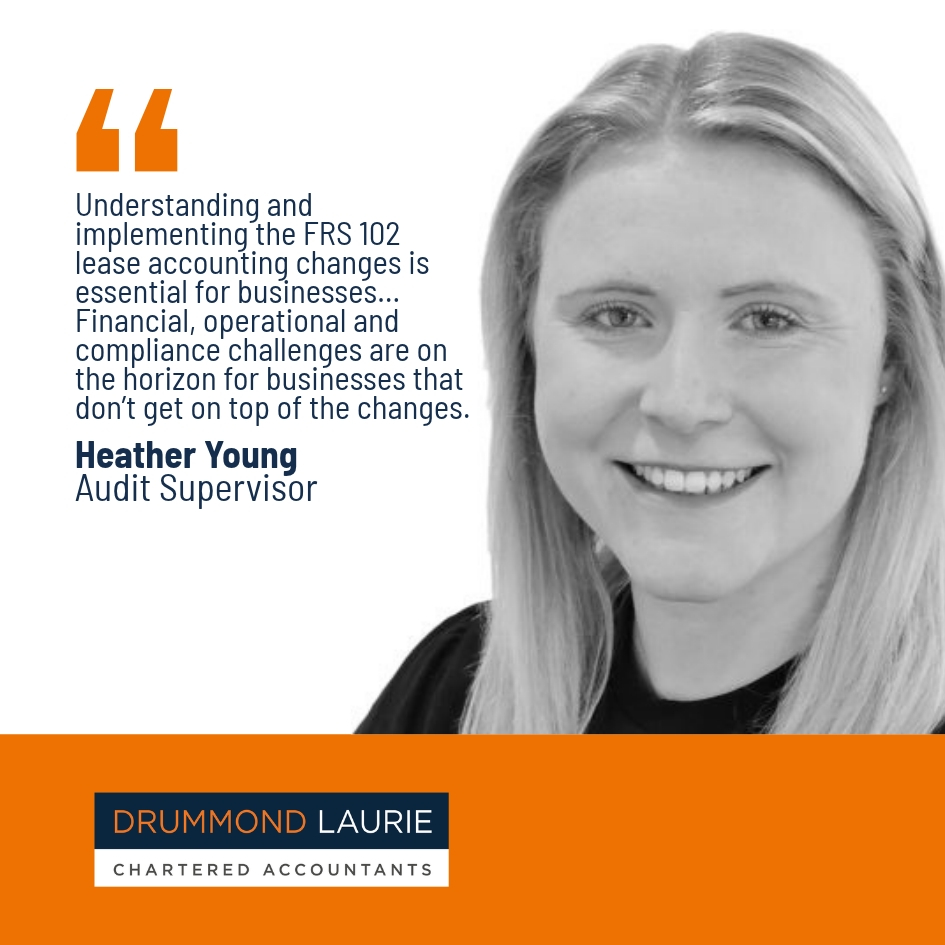
Understanding and implementing the FRS 102 lease accounting changes is essential for businesses of all sizes. Financial, operational and compliance challenges are on the horizon for businesses that don’t get on top of the changes.
Drummond Laurie Chartered Accountants are supporting businesses to adapt to the new rules with:
- Initial impact assessments: Identifying leases within scope and explaining the potential accounting implications
- Lease accounting calculations: Assisting with the calculation of right-of-use assets, lease liabilities, depreciation and interest charges
- Transition support: Helping businesses establish opening balances and implement the revised requirements
- Financial reporting and disclosures: Assisting with the preparation of accounts in accordance with FRS 102
- Commercial impact reviews: assessing the potential effects on management accounts, financial forecasts and lending covenants
- Ongoing advice: providing support as lease arrangements are entered into, amended or renewed.
If your business has existing lease commitments, now is the time to consider how these changes may affect your financial statements.
For an initial discussion and to learn how we can get your business ready, get in touch with Heather Young.
Connect with Drummond Laurie Chartered Accountants on LinkedIn, Facebook and X
About the author
Heather Young graduated from Stirling University with a degree in Accountancy and Finance. She subsequently qualified as a Chartered Accountant with the Institute of Chartered Accountants of Scotland (ICAS).
Connect with Heather on LinkedIn.